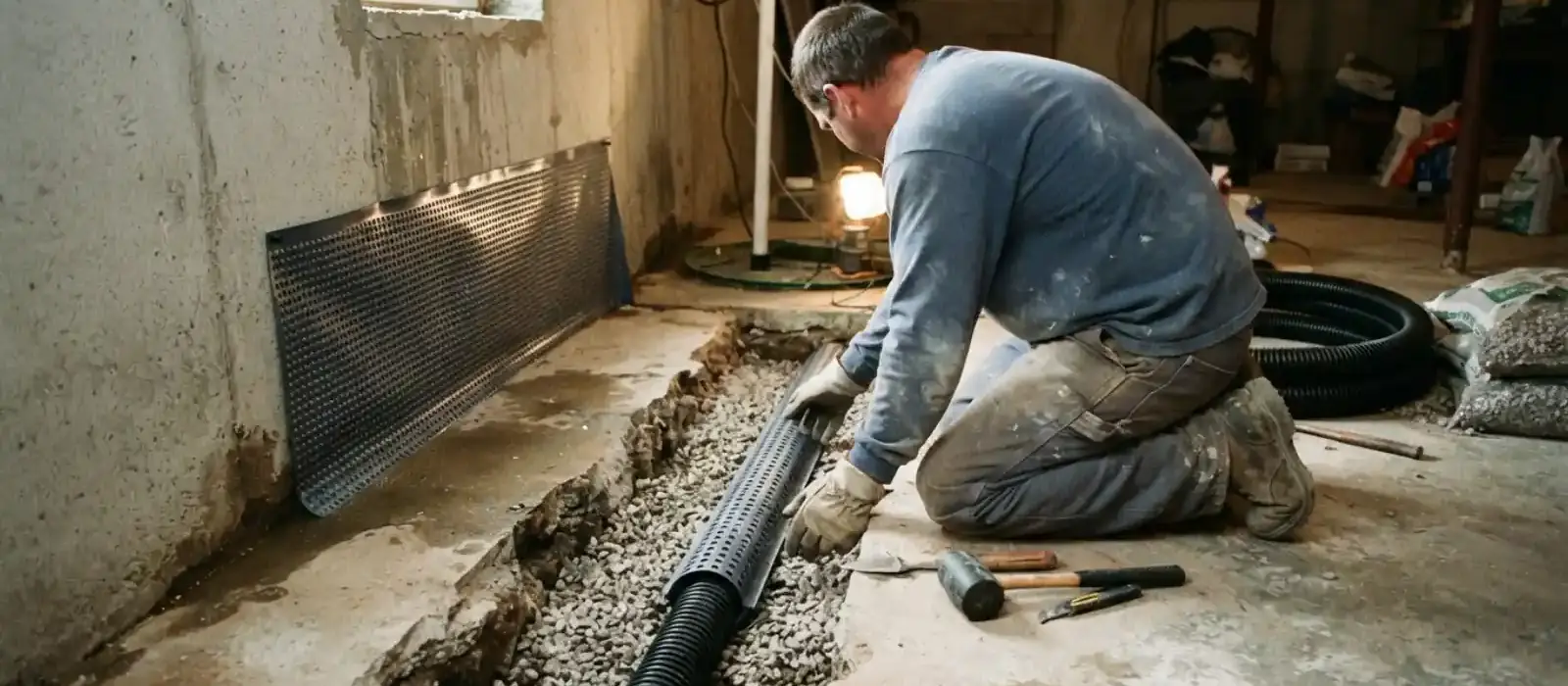
Where basement water comes from
Water enters a basement for a few reasons. Rain flows toward the foundation because of poor grading or short downspouts. Groundwater rises and presses on the walls and floor.
A floor joint or a crack gives it a path. Plumbing leaks can also add to the problem, so the source needs identifying.
A plumber starts with the outside. Gutters, downspouts and grading often explain a great deal. Inside, the pattern of staining tells a story.
Water at the wall base points one way, and water in the middle of the floor points another. Drain and pump work in a basement follows International Plumbing Code (IPC) standards for discharge, and safety guidance applies: never stand in water near electrical equipment.
Waterproofing approaches compared
Each approach suits a different cause.
| Approach | What it does | Best for |
|---|---|---|
| Exterior grading and gutters | Directs rain away from the foundation | Seepage after rain with poor drainage |
| Interior drain and sump | Collects water at the floor edge and pumps it out | Recurring seepage and high groundwater |
| Crack and joint sealing | Fills specific cracks | Isolated leaks, not widespread seepage |
| Wall and floor coatings | Slows moisture | Dampness only, not active flow |
Signs the basement needs attention
These clues tell you to act before the damage grows.
- ✓Damp patches or staining on walls and at the wall base.
- ✓White powdery deposits called efflorescence.
- ✓A musty smell that returns after cleaning.
- ✓Peeling paint or bubbling wall finishes.
- ✓Standing water after heavy rain.
Basement damp or leaking?
Call to book an assessment. We will explain what we see and what each option costs.
Why the pump and the drain work as a pair
An interior drain collects water at the edge of the floor and channels it to a sump pit. The pump then discharges it away from the house. The system works only if both halves work, so a plan for a drain without a reliable pump is incomplete.
For the pump half, read the sump pump installation and repair page. Ask about battery backup if you finish the space, since a flooded finished basement costs far more than the system that would have prevented it.
Neshaminy Creek, rain and the bigger picture
Bensalem sits between the Neshaminy Creek on its eastern side and the Poquessing Creek on the west, and heavy rain events raise groundwater across low-lying areas. The remnants of Hurricane Ida in September 2021 delivered 4 to 10 inches of rain across Bucks County.
A single storm does not prove your basement needs waterproofing. A pattern of seepage does. Keep notes on when water appears and where, and share them with the plumber. That log saves time and focuses the assessment.
What shapes a waterproofing quote
Waterproofing is priced by the system, not by the hour.
Insurance note. Seepage and groundwater are often excluded from standard homeowners coverage. Review your policy and ask about water backup endorsements.
Want your real number? Call (215) 714-6692 and describe the job.
Common questions
A well-planned system controls water far better than none, but no system is a guarantee. We explain what to expect for your situation.
No. Plumbing leaks, condensation and poor grading can cause dampness too. We check these first.
If you have an interior drain system, yes. A pump moves the collected water out of the house.
A sealing or gutter fix may take hours. An interior drain system takes several days.
Controlling moisture helps prevent mold, but existing mold needs separate remediation.