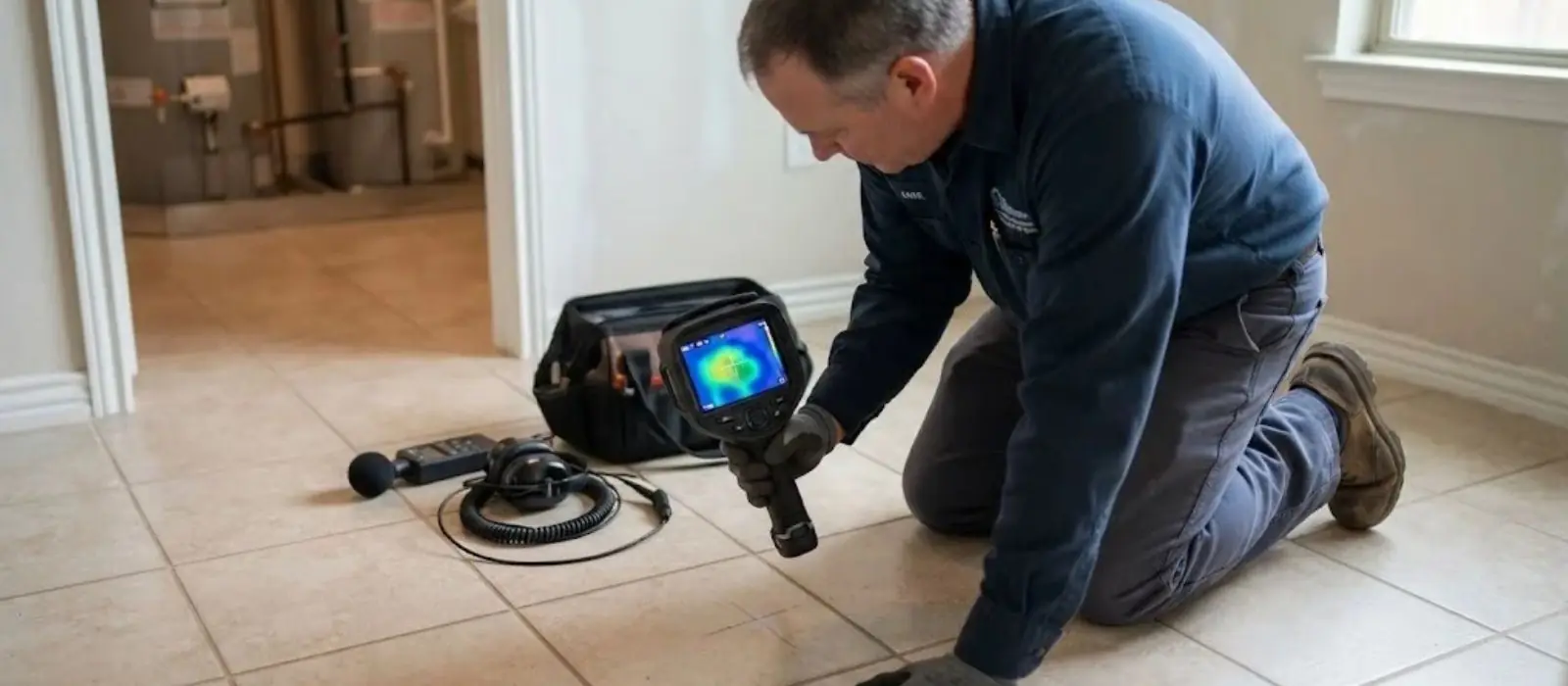
When a hidden leak cannot wait
Water you can hear but cannot see is already doing damage. A leak behind a ceiling can bring down drywall, and a leak under a slab can undermine flooring. If water is pooling, dripping through a ceiling or running at the meter, treat it as urgent.
The line is answered at any hour, and same-day service is offered when the schedule allows. These steps limit the damage while you wait. Repairs after a leak is found follow the International Plumbing Code (IPC), and any pipe that is opened up should be pressure tested to the same standards before it is closed.
- !Shut off the main water valve and see whether the sound or the dripping stops.
- !Place a bucket under active drips and move furniture out of the wet zone.
- !Switch off power to any room where water is near outlets or light fixtures.
- !Photograph the damage and the meter reading for your insurer.
How we find a leak without tearing things open
Detection works by narrowing the search step by step instead of guessing.
- 1
Isolate the system
Close fixtures and test whether the meter still moves, which separates a leak from normal use.
- 2
Pressure test
Gauges on the supply lines show which section loses pressure and narrow the search.
- 3
Listen and scan
Acoustic and thermal tools pinpoint the spot through floors, walls and soil.
- 4
Confirm and quote
We mark the location and explain the repair options and price before cutting anything.
Where leaks hide and how they show up
The symptom points to the zone. Zones need different tools.
| Symptom | Likely zone | First test |
|---|---|---|
| Warm patch on a floor | Hot supply line under a slab | Thermal scan and pressure test |
| Water bill jumps, nothing visible | Underground service line or toilet | Meter test, dye test |
| Stained ceiling below a bathroom | Supply or drain line in the floor above | Moisture meter and fixture checks |
| Soggy lawn strip, no rain | Buried line between meter and house | Acoustic locating |
| Sound of running water at night | Any pressurized line | Isolation test by zone |
Slab leaks: what they are and what to do
A slab leak is a leak in a pipe that runs in or under a concrete floor slab. It is most often a hot or cold supply line, and it can cause warm floors, a sudden rise in the water bill or the sound of running water with fixtures off. Homes built on a slab have no basement to carry the water away, so the damage spreads under flooring.
A pressure test and a thermal or acoustic scan locate the line without breaking the slab first. The options then run from rerouting the line through the walls or ceiling to repairing it in place. For the cases where several lines are failing, read about repiping before agreeing to a string of small repairs.
Water meter and high-bill checks
A sudden jump on the water bill is often the first sign of a leak. The meter gives you a free test: turn off every tap and appliance, then watch the low-flow indicator on the meter. If it moves, water is leaving the system somewhere.
The usual suspects are a toilet that runs, an irrigation line or a leaking service line. A toilet dye test costs almost nothing. If the toilet is clean and the meter still moves, the leak is likely between the meter and the house, and a water service line repair may be next. Your water utility can also tell you whether your usage pattern changed, so ask for the account history.
Water bill jumped or a wall feels damp?
Call and describe what you see. We will suggest the first test.
Ceiling and wall leaks in Bensalem homes
Stains on a ceiling are rarely just where the leak starts. Water travels along joists and pipes before it shows, so the stain can sit several feet from the source. A moisture meter and a few controlled fixture tests find the true origin, which often turns out to be a bathroom supply line, a tub drain or a roof issue.
Do not paint over a stain until the source is confirmed. If the leak turns out to be a failing supply line, a repair is small. If it is a burst section, the burst pipe repair page explains what happens next.
What affects the price of leak detection
Detection is priced by the effort needed to find the leak, not by a flat rate.
Insurance note. Many homeowners policies cover resulting water damage from a sudden leak but not the cost of finding or repairing the failed pipe. Ask your agent about access and tear-out coverage.
Want your real number? Call (215) 714-6692 and describe the job.
Common questions
Warm spots on the floor, the sound of running water with all fixtures off and an unexplained bill increase are common signs. A pressure test confirms it.
Yes. The line is answered at any hour, including nights and weekends, and a plumber can be scheduled for the same day when the schedule allows. Shut the main valve first if water is actively flowing.
In most cases yes. Pressure, acoustic and thermal tools narrow the search before any cutting.
Check the meter with everything off, then run a dye test in each toilet. Call us if the meter still moves.
Coverage varies. Some policies cover access to the leak after a sudden loss. Ask your agent before work starts.
Yes. See commercial plumbing for building-wide and multi-unit work.