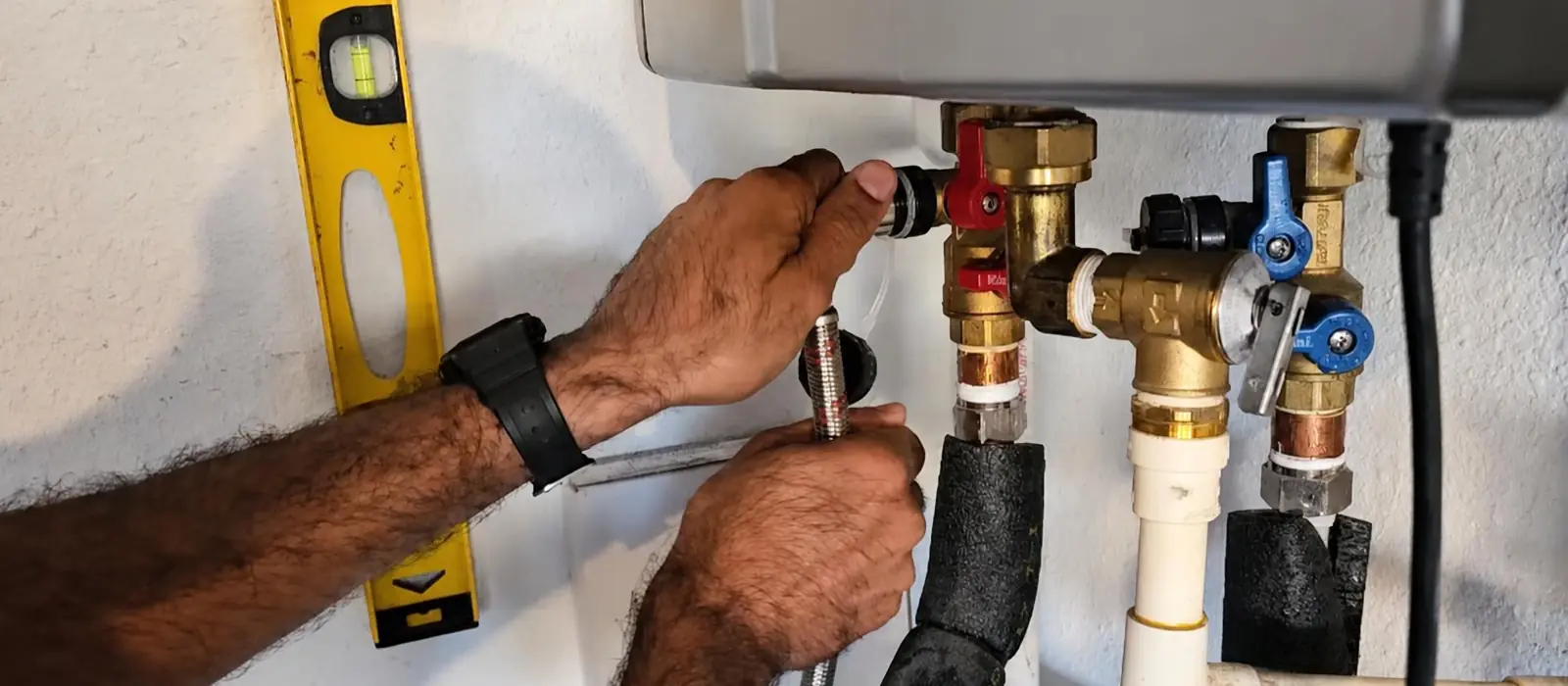
Why tankless units need service at all
A tank heater stores hot water. A tankless heater heats water as it flows, so every drop passes through a narrow heat exchanger. Dissolved minerals in the water form scale on the hot metal, and the scale narrows the passage and insulates the metal from the water.
The result is a unit that works harder for less heat. The first sign is a lower flow rate. The next is an error code. Many manufacturers recommend an annual flush for this reason.
Without service, the warranty may also be at risk, so read the manual. The maker's service guidelines set the flush interval and the solution to use, and venting repairs follow International Plumbing Code (IPC) standards.
What a service visit covers
The scope depends on the model, but most visits include these checks.
| Item | What the plumber does | Why it matters |
|---|---|---|
| Heat exchanger flush | Circulate a descaling solution through service valves | Removes scale, restores flow |
| Inlet filter | Remove and clean the screen | Debris reduces flow and sets off codes |
| Venting | Inspect the vent path and terminations | Blocked venting stops the burner |
| Gas and combustion | Check pressure and flame quality | Poor combustion wastes fuel and is a safety risk |
| Error history | Read stored codes | Shows patterns before failure |
Warning signs between visits
Do not wait for the annual service if you see these.
- ✓Water that cycles from hot to cold during a shower.
- ✓Reduced hot water flow at every tap.
- ✓An error code that returns after a reset.
- ✓A kettle-like noise as the unit fires.
- ✓Visible scale at the inlet or in faucet aerators.
What a homeowner can and cannot do
Cleaning the inlet filter is within reach of most homeowners. Pull the filter, rinse it and put it back. A flush needs service valves, a pump, hoses and a descaling solution, and it takes about an hour. Units installed without service valves cannot be flushed until valves are added.
Anything involving gas or venting belongs to a plumber. A bad vent can cause carbon monoxide, and a gas leak is an emergency. For the full set of tankless repairs we handle, see the tankless water heater page.
Local note: ask your utility about water quality
How often you flush depends on your water. We do not publish a hardness number for Bensalem, because it changes by address and we have no primary source to cite. Your water bill names your utility. Ask it for its annual water quality report, and compare it with a home test strip.
If the water tests hard, shorten the interval or consider a softener ahead of the heater. Homes in Bristol and Feasterville-Trevose may be served by different utilities than a Bensalem address, so the report you need is the one for your street.
Reading error codes without guessing
Every brand uses its own code list. The manual's table tells you what a code means, and the unit often stores a history. Write the code down before you reset, because a reset hides the pattern.
Common themes are ignition failure, flow too low, overheating and vent blockage. Ignition and flow codes are the most common after scale. A plumber can tell whether a code is a quick clean or a part. If the unit needs replacement instead, read water heater replacement before you decide.
A realistic annual service plan
Treat the tankless heater like any other appliance with a maintenance schedule. Once a year, check the inlet filter, read the error history and flush the exchanger if the water is hard. Keep a short log with the date and what you found.
A log helps a technician later. If a code first appeared eight months ago and keeps returning, that pattern points to a cause. A single code with no history is a guess.
What to keep near the heater
A few items make service easier.
- ✓The manual, with the error code table marked.
- ✓The model and serial number written on the wall or in your phone.
- ✓A note of when the unit was installed and last flushed.
- ✓A spare inlet filter if your model uses a common size.
- ✓The name of the plumber who installed it, in case of warranty questions.
Tankless unit throwing a code?
Call with the model and the code. A plumber will tell you what to expect.
Common questions
Many manufacturers recommend yearly. Hard water calls for more often. Check the manual and your water report.
Not effectively. A flush needs a pump and a descaling solution circulated through service valves.
No. Some installs omit them, and valves must be added before a flush.
Often, if scale is the cause. If a sensor or part has failed, repair is needed.
Your water bill names your utility. Ask for its annual water quality report for your address.