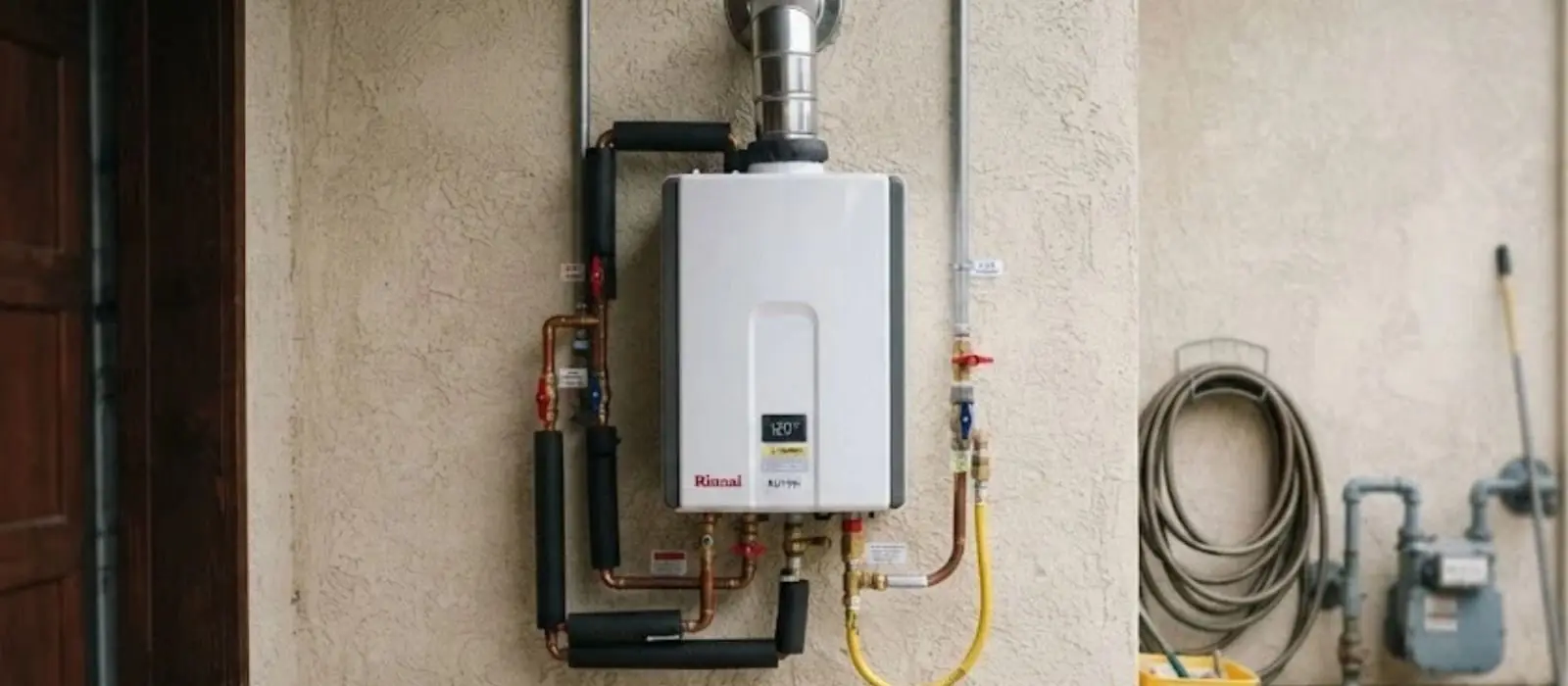
How a tankless unit works and why it fails
A tankless heater fires a gas burner or powers electric elements only when a tap opens. Water passes through a heat exchanger, picks up heat, and leaves at the set temperature. There is no stored hot water, so the unit must deliver full heat at the flow rate you demand.
That design explains the failures. Minerals form scale on the exchanger and restrict flow. A blocked vent or low gas pressure starves the burner. A flow sensor clogged with debris misreads the demand.
Each cause has a different fix, and a flush solves only one of them. A tankless install follows the maker's installation guidelines for gas sizing and venting as well as International Plumbing Code (IPC) standards, and both should appear in the scope.
Signs a tankless unit needs service
Most failures give a warning before the unit quits. Safety steps come first: if you smell gas, leave and call the gas utility, and otherwise watch for these.
- ✓An error code on the display that returns after a reset.
- ✓Water that runs hot, then cold, then hot again during a shower.
- ✓Reduced hot water flow at every tap even though the supply is normal.
- ✓A rumbling or kettle-like sound as the unit fires.
- ✓Visible mineral crust at the water inlet or in faucet aerators.
Flush, repair or replace
The right response depends on the symptom and the age of the unit.
| Situation | Common cause | Typical response | |
|---|---|---|---|
| Error code and reduced flow | Scale in the heat exchanger | Descale flush with a pump and cleaning solution | |
| Error code for ignition failure | Dirty flame rod or gas pressure | Clean or replace parts, check gas supply | |
| Intermittent cold water | Flow sensor or mixing issues | Test and replace sensor | |
| Leaking from the cabinet | Cracked heat exchanger | Replacement, see [[water-heater-replacement | water heater replacement]] |
Flushing and descaling
A proper flush connects a small pump to the service valves and circulates a descaling solution through the heat exchanger. Garden hose tricks without isolation valves do not reach the scale. Units installed without service valves need them added before a flush is possible.
How often to flush depends on the water. No single hardness figure applies to every address, so test your tap or ask your water utility for its water quality report. A home with noticeably hard water should be on a shorter interval than one with soft water.
Tankless unit acting up?
Call with the error code and the model, and we will outline the likely fix.
Installing a first tankless unit in a Bensalem home
Converting from a tank to tankless is more than a swap. The gas line may need to be larger, the vent changes to a sealed sidewall run, and a condensate drain may be needed for high-efficiency models. A new circuit may be needed for the control board as well.
The township uses the International Plumbing Code under Pennsylvania's Uniform Construction Code, and the Building and Planning office at 215-633-3644 can tell you what applies. For a full scope discussion, see water heater installation, which covers site checks and venting in more detail.
Questions about hard water and scale
Scale is the leading cause of tankless failures, and it is a water chemistry problem more than an equipment problem. A softener or scale inhibitor ahead of the heater can extend its life, but only if the water actually needs it.
Do not assume. A basic hardness test strip costs a few dollars. If the strip shows high hardness, discuss a softener or a filter with your plumber before the unit is installed rather than after the first flush.
What affects tankless service pricing
Service calls, flushes and installations are priced differently.
Insurance note. A tankless failure that causes water damage is evaluated like any other sudden loss. Normal wear and descaling are maintenance items.
Want your real number? Call (215) 714-6692 and describe the job.
Common questions
Follow the manufacturer's interval and shorten it if your water is hard. Test your tap or ask your utility for its water quality report.
We service common brands. Tell us the model and the error code when you call.
Common causes are low flow, a scaled heat exchanger or a sensor issue. A technician can test each one.
Most manufacturers recommend periodic service. The right interval depends on water quality and use.
It depends on household size, gas supply and venting options. We can talk through the choices on a call.